
Atmanirbhar Bharat in Defence: Production (₹1.78 Lakh Crore), Private Sector Share (24%), and Export Scaling (₹38,424 Crore)
Examining the transformation of India’s defence industrial base across DPSUs, private manufacturers, MSMEs, defence corridors, and export markets in 80+ countries.
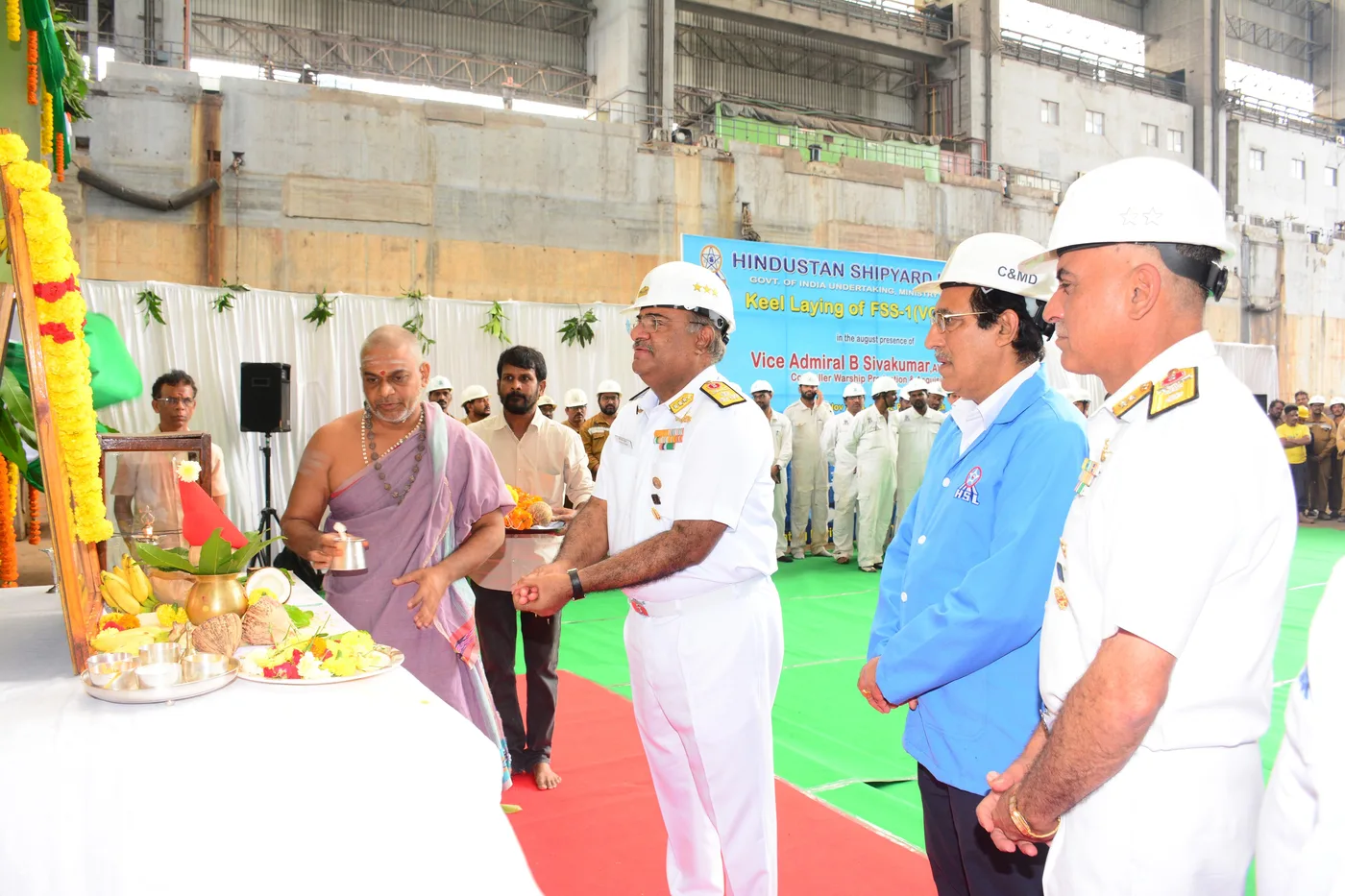
PLATE V (PIB PRID 2073452) — Keel-laying ceremony of the first 44,000-tonne Fleet Support Ship (FSS) at Hindustan Shipyard Limited (HSL), Visakhapatnam, presided over by Controller Warship Production & Acquisition (CWP&A).
1. Key Industrial Benchmarks (FY 2025–26)
India’s defence manufacturing ecosystem has shifted from licensed assembly toward indigenous design, sub-system localisation, and global export competitiveness. Official figures for FY 2025–26 establish four structural benchmarks:
| Indicator | FY 2025–26 Official Benchmark | Strategic Significance |
|---|---|---|
| Total Defence Production | ₹1.78 lakh crore | Highest recorded annual domestic defence output |
| Private Sector Production Share | ~24% | Growing private participation alongside DPSUs |
| Total Defence Exports | ₹38,424 crore | Sustained international adoption of Indian systems |
| Private Sector Export Contribution | ₹17,353 crore | Roughly 45% of total defence exports driven by private firms |
| Export Reach | 80+ countries | Diversified footprint across Asia, Africa, Europe & Americas |
2. Structural Pillars of the Industrial Base
2.1 Defence Public Sector Undertakings (DPSUs)
Organisations including HAL, BEL, BDL, Mazagon Dock, GRSE, Cochin Shipyard, and BEML anchor heavy platform integration across combat aircraft, helicopters, warships, submarines, guided missiles, and radar networks.
2.2 Private Sector Primes & Specialised Manufacturers
With approximately 24% share of total production and ₹17,353 crore in exports, private Indian firms now deliver artillery systems, armoured vehicles, naval vessels, aerostructures, electronics, small arms, and unmanned platforms.
2.3 MSMEs, Startups & Industrial Corridors
Thousands of Micro, Small and Medium Enterprises (MSMEs) and iDEX startups supply critical sub-assemblies, sensors, composites, and software across the Uttar Pradesh and Tamil Nadu Defence Industrial Corridors.
3. The “Border to Boardroom™” Analytical Continuum
Defence Observer evaluates industrial capability through a six-stage chain:
- Border: Operational reality and terrain requirements of the soldier;
- Policy: Positive indigenisation lists and domestic capital reservation;
- Industry: Manufacturing scale, quality assurance, and supply-chain resilience;
- Technology: Indigenous IP in seekers, propulsion, materials, and AI;
- Diplomacy: Government-to-government lines of credit and attaché facilitation;
- Boardroom: Long-term capital formation and institutional partnerships.
Ministry of Defence (PIB) Disclosures & Doctrinal Synthesis
Official Government of India Press Information Bureau (PIB) records corroborated and synthesized for this research monograph under our 5-Level Verification Protocol.
Shipyard Industrial Scaling: The 44,000-Tonne Fleet Support Ship Programme and Private-MSME Supply Chain Integration
The keel of the first of five 44,000-tonne Fleet Support Ships (FSS) contracted to Hindustan Shipyard Limited (HSL), Visakhapatnam in August 2023 was laid in the presence of Vice Admiral B. Sivakumar, Controller Warship Production and Acquisition, generating nearly 168.8 lakh mandays of employment across Indian MSMEs.
Blue-water naval power is ultimately bounded by underway replenishment endurance; five 44,000-tonne Fleet Support Ships allow Indian Carrier Battle Groups to remain on station across distant Indo-Pacific theatres without foreign port reliance. Doubles the Indian Navy’s high-tonnage replenishment fleet while providing dual-use Humanitarian Assistance and Disaster Relief (HADR) sealift capacity across the Indian Ocean Rim.
DPSU Corporatisation & Order-Book Economics: Evaluating the ₹1.27 Lakh Crore Domestic Production Milestone
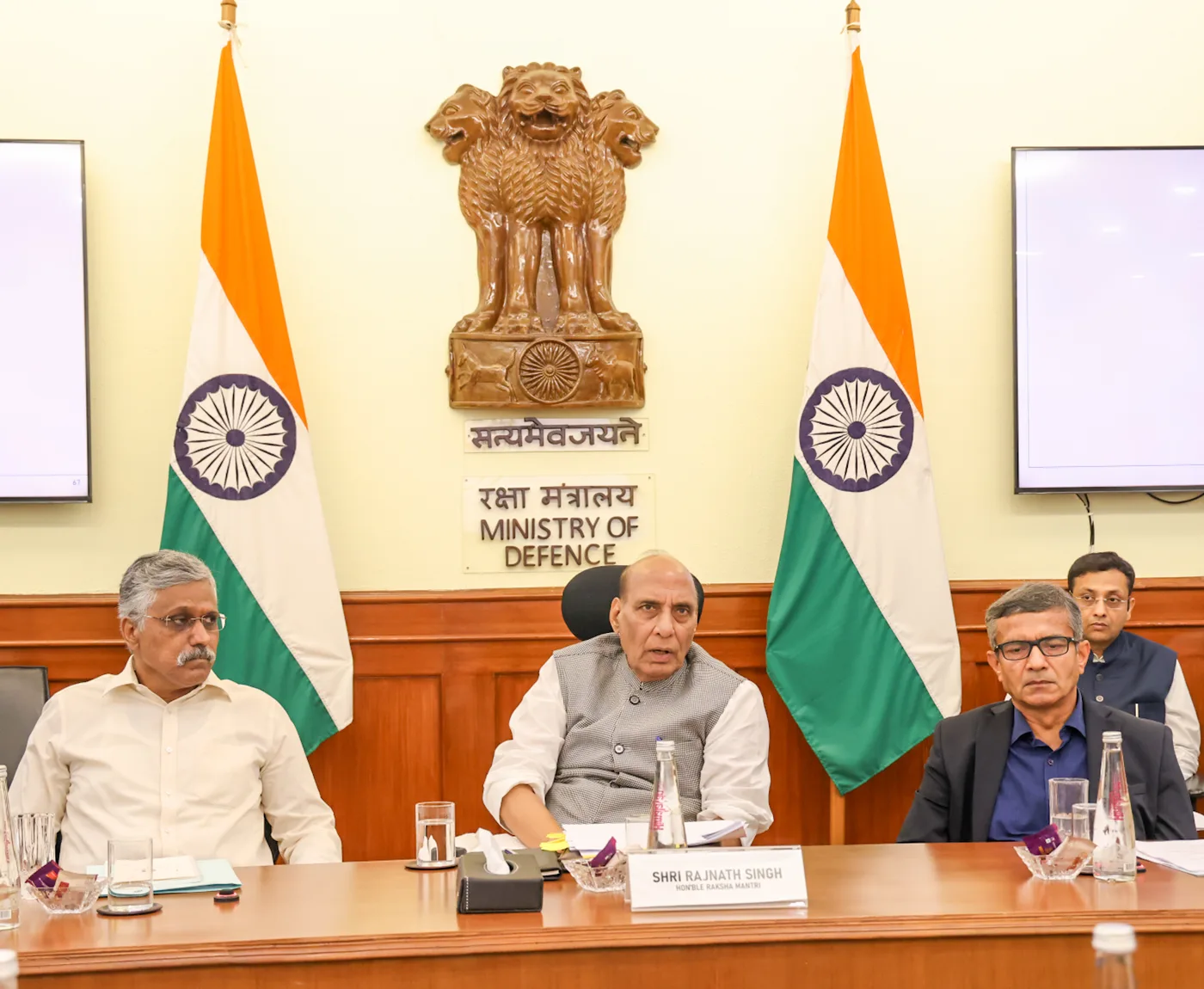
Raksha Mantri reviewed the physical and financial output of Defence Public Sector Undertakings (DPSUs), receiving ₹1,620 crore in dividend cheques alongside confirmation that India’s annual defence production reached an all-time high of ₹1,26,887 crore (~₹1.27 lakh crore) with 79.2% contributed by DPSUs and 20.8% by the private sector.
Sustained high-intensity warfare requires sovereign surge capacity in artillery shells, propellants, radar spares, and aviation MRO—a lesson reinforced by the corporatisation of the former Ordnance Factory Board into seven profitable DPSUs. Insulates the Indian Armed Forces from wartime embargo risks across critical ammunition, tank barrels, naval hulls, and tactical electronics.